

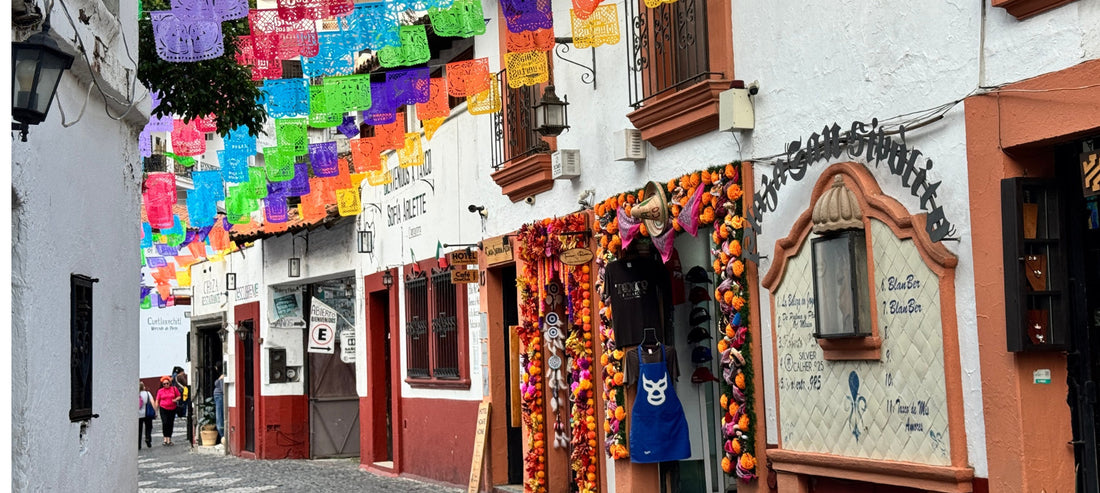
The Arrival: Marigolds, Memory, and the Rhythm of Taxco
When I arrived in Taxco on a Tuesday in late October 2026, just a week before the solemn and joyous celebrations of Día de Muertos on November 1st and 2nd, the historic silver town was already beating with its usual vibrant energy. But there was something deeper shifting in the air. Weeks previewing the festivities, the town was slowly, bit by bit, beginning to transform.
Bright orange cempasúchil—traditional Mexican marigolds—started appearing on doorsteps, winding up stone staircases, and spilling out of market stalls. If you walked past the iconic, towering pink-stone facade of the Santa Prisca church, you could witness the meticulous preparation of the monumental floral tapestry—a breathtaking tradition that has officially graced the plaza since around 2016. Watching it come together piece by piece is a remarkable sight: a sprawling canvas of petals and devotion taking shape right in the heart of the town.
By Friday, the rhythm quickened. Guided groups of tourists began flowing downtown, filling the colonial alleyways with chatter and motion. And then came Saturday.
The Saturday Crescendo
If you arrive in Taxco on a Saturday, you are met with a sensory overload. Streets and streets of vendors stretch across the hillsides, feeding into a massive three-story market packed tighter than memory allows with silver of every description. It is loud, it is sprawling, and it is the commercial heartbeat of daily trade.

Let’s be clear: the pieces on that market are not mass-produced factory trinkets. They are still shaped by local hands and families making an honest living. But here is the reality that most visitors, even coming from all over Mexico, never see: unless you have a deep grasp of Taxco's history and the evolution of its silver trade, you simply won't be curious enough to dig beneath the surface. Without that context, that hidden layer of contemporary masters remains completely invisible.
It is only when you understand that these masters exist—and when you confront the harsh economic realities they face today—that you learn the full truth: even some of those brilliant creators, artists capable of breathtaking, museum-grade sculpture, will produce simpler, everyday market pieces just to sell on a Saturday so they can feed their families.
Without steady exposure or a local market with the purchasing power to acquire true masterpieces, these brilliant creators are forced to spend their time on basic production just to survive.
Breaking Through the Membrane
For a long time, like so many of the travelers I was referring to, I stayed on the surface. It took me years of dedicated fieldwork, of walking quiet alleyways and building deep, trusting relationships with generational families, to finally break through that commercial membrane.

That fieldwork took on an entirely new depth on this trip when I had the privilege of meeting Lily Castillo—the daughter of the legendary Antonio Castillo, one of the greatest masters of that golden era who helped shape and launch Taxco onto the international stage. As I sat with her and shared my deep commitment to supporting contemporary artisans and meeting personally with every workshop behind Nueve Sterling, she listened and referred to my work as that of a "social archaeologist." It was a humbling and revealing moment that crystallized the very nature of this journey: unearthing and protecting the living history of a craft that so easily stays hidden beneath the commercial noise.
Lily Castillo (left) and Maria Rocher
I respect the Saturday market as a vital part of Taxco’s daily economy. But that is not what I am pursuing for Nueve Sterling. That is the surface layer.
To find the true artistic pulse of Taxco, you have to look beyond the market stalls. That is where my work as an "empirical social archaeologist" began—moving past the noise to find the quiet, brilliant master workshops, the historical archives, and the living heritage that defines the town's true genius.
Nueve Sterling as a Global Showcase
That is where Nueve Sterling steps in. That is the exact role I want to play: a global showcase and a window to the world for these artisans. My mission is to open up international doors for these independent workshops, connecting their extraordinary mastery with patrons who can truly see, appreciate, and afford the profound level of artistry they pour into their work.

Walking these cobblestone streets on this trip, I couldn't help but soak in the quiet beauty of a town that has preserved its charm through decades—a place that justly earned the designation of a Mexican Pueblo Mágico. But beyond the beauty of the colonial facades and the cempasúchil blossoms, what mattered most was being able to make myself present for these artisans, to sit with them, and to meet new faces carrying the torch.

I refuse to think that this generational knowledge will stop its course. There is too much work to be done—ensuring that the new generations feel inspired to craft masterpieces just as their parents and grandparents did before them. The people mastering these brilliant techniques deserve to be recognized and supported so they feel encouraged to share their wisdom.
This story of silver, art, and human resilience is far from over. And I am here to make sure it doesn't stop any time soon.


