

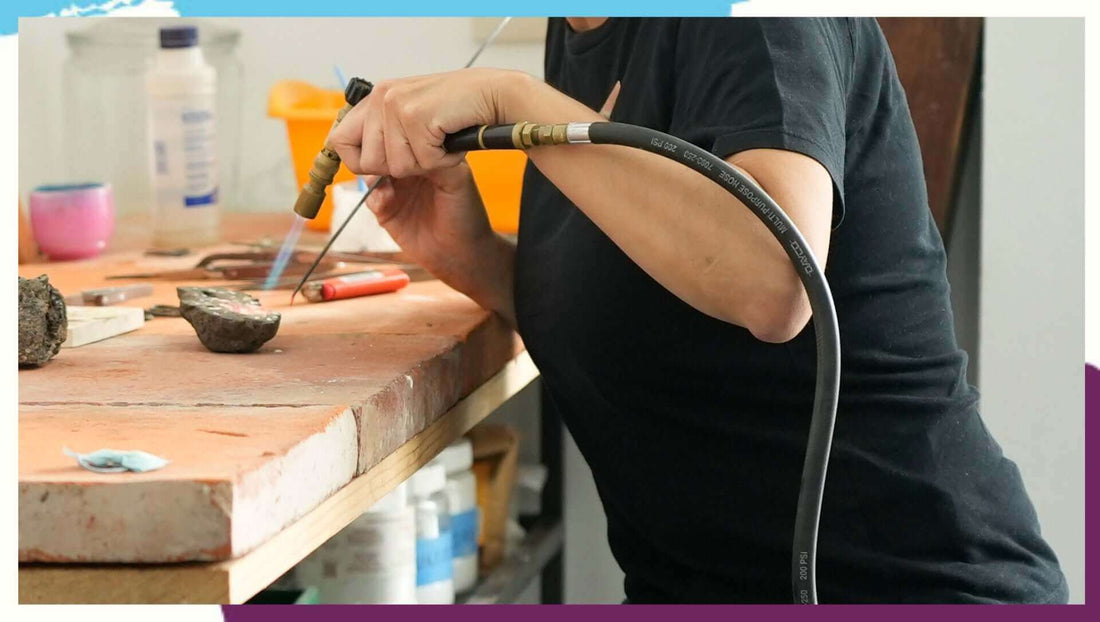
Un héritage en mouvement
La beauté d'une pièce en argent faite à la main réside souvent dans ce que l'on ne peut pas voir : le martèlement rythmé d'un atelier à l'aube, les décennies de secrets hérités et la farouche indépendance des artisans qui refusent de laisser un métier disparaître.
Dans ce paysage moderne, pour ceux qui recherchent la meilleure option en ligne pour des bijoux en argent faits à la main avec un artisanat de haute qualité, je crois que le voyage (même numérique) doit éventuellement mener aux rues pavées de Taxco, au Mexique : la capitale mondiale de l'argent.
Bien que ce métier ait été historiquement mené et dominé par les hommes, transmis de père en fils pendant des générations, nous ne pouvons pas ignorer les femmes extraordinaires qui contribuent à cimenter le présent de l'argent de Taxco en faisant le pont entre des siècles de tradition et une maîtrise moderne et sophistiquée.
Dans ma curation pour Nueve Sterling, je considère le véritable artisanat comme une conversation entre le passé et le présent.
Les fondations féminines de l'excellence : l'artisanat de haute qualité au cœur de Taxco
La réputation de Taxco s'est construite sur une base de collaboration. Bien que de nombreux grands ateliers historiques aient été dirigés par des hommes, je me penche toujours sur deux femmes qui ont créé un espace qui a changé à jamais l'esthétique de l'argent mexicain.
Margot de Taxco : l'alchimiste de l'émail

Dans les années 1950, Margot van Voorhies Carr (qui est devenue Margot de Taxco) a introduit une sensibilité artistique distincte dans l'industrie de l'argent déjà florissante de Taxco. Sa contribution la plus remarquable a été l'affinage et l'élévation de la technique de l'émail champlevé sur argent, la transformant en l'une de ses réalisations phares.

La technique : Au lieu de simplement peindre sur les bijoux, le travail de Margot nécessitait de creuser ou de couler soigneusement de petits renfoncements dans l'argent sterling et de les remplir de poudre de verre. Le verre était ensuite chauffé jusqu'à ce qu'il fusionne avec le métal, produisant une surface vive et brillante qui ressemblait à une mosaïque sertie dans l'argent.
Une vision distinctive : Les créations de Margot s'inspiraient de l'élégance de l'Art Déco et de la beauté délicate des motifs japonais. Elle est devenue célèbre pour ses émaux riches aux tons de pierres précieuses — bleu sarcelle profond, rouge vif et noir brillant, souvent arrangés en motifs géométriques raffinés ou en motifs floraux délicats.
Précision et grâce : Margot était connue pour sa nature méticuleuse. Elle avait même un modèle en bois de poignet de femme dans son atelier pour s'assurer que ses bracelets articulés tombaient parfaitement, montrant que son innovation valorisait à la fois le confort et l'art. Jaime Quiroz, qui l'a accompagnée lors de voyages de vente aux États-Unis de 1964 à 1970, a noté qu'une partie du succès des bijoux de Margot venait de la perspicacité d'une femme créant pour des femmes (Morrill, Mexican Silver: Modern Hand-wrought Jewelry & Metalwork, p. 170). Cette compréhension de l'ajustement et de la portabilité était aussi centrale à son travail que son élégance, aidant ses pièces à atteindre à la fois style et praticité.
Matilde Poulat (MATL) : La visionnaire baroque
Si Margot était la maîtresse de la couleur à travers le verre, Matilde Poulat était la maîtresse de la couleur à travers la nature. Son style est souvent décrit comme le baroque mexicain, une esthétique exubérante, très ornée, profondément liée à l'âme du Mexique.
Le style MATL inimitable : Après avoir été inspirée par la découverte en 1932 de bijoux en or mixtèques à Monte Albán, Matilde a rejeté les influences européennes au profit d'une esthétique indigène. Ses pièces se caractérisent par un repoussé complexe (martelage de l'argent par l'arrière pour créer du relief) et un travail de filigrane délicat, souvent avec des motifs fantaisistes comme des colombes (palomas), des fleurs et de petites clochettes (cascabeles).
La marque de fabrique de MATL en pierres précieuses : Les créations de Matilde sont instantanément reconnaissables par leur utilisation caractéristique de pierres précieuses naturelles, en particulier le corail, la turquoise et l'améthyste.

Turquoise et Corail : Elle utilisait souvent de petits cabochons de turquoise et de corail rouge taillés à la main, les sertissant dans des chatons serrés et ondulés qui agissaient comme des points de lumière sur l'argent oxydé et assombri.
Améthyste pyramidale : Une caractéristique de sa conception était l'utilisation d'améthystes pyramidales ou "en forme de cerf-volant". Ces pierres n'étaient pas seulement décoratives ; elles ajoutaient une qualité architecturale et tridimensionnelle à ses colliers et croix, donnant aux bijoux l'impression d'être un objet sacré.
Symbolisme et Cœur : Pour Matilde, chaque pierre et chaque clochette en argent avait une signification. Les cascabeles représentaient la fidélité et l'amitié, tandis que ses créations "Palomas y Rosas" capturaient le romantisme d'une époque révolue. Son travail était si distinct qu'il était collectionné par des icônes de l'époque, de Frida Kahlo à l'élite hollywoodienne, tous attirés par la "mexicanité" de ses créations parées de bijoux.
Les maîtres qui cimentent l'art de Taxco aujourd'hui
À Taxco, l'argent est l'âme de la famille. Les maîtres femmes qui façonnent des chefs-d'œuvre grâce à leur vaste imagination sont des autorités établies, ancrant l'artisanat dans notre ère moderne. Elles honorent les hommes qui les ont formées en repoussant les limites de ce qui est possible sur l'établi du bijoutier.
Carmen Tapia : une philosophie de la forme

Carmen Tapia est l'exemple parfait de la coexistence entre héritage et innovation. Fille du célèbre sculpteur et orfèvre Ezequiel Tapia (honoré à Taxco en 2025 pour l'ensemble de ses contributions), Carmen a grandi dans l'atelier familial.
Son travail est un exemple de collaboration. Depuis 2018, elle travaille aux côtés de Chabelo Suárez Aréchiga, un maître platero avec plus de 30 ans d'expérience. Ensemble, ils forment une équipe redoutable, alliant le parcours de Carmen en philosophie et arts visuels à la maîtrise de Chabelo en forge et repoussé.
Carmen Tapia est l'une des voix les plus accomplies de l'orfèvrerie contemporaine de Taxco. Au cours de sa carrière, elle a obtenu plus de vingt distinctions, dont trois Prix nationaux de la bijouterie (2005, 2007, 2009) au prestigieux Concours national de platería de Taxco. Elle a également été honorée du Prix William Spratling et du Prix du gouvernement de l'État dans le même concours – des reconnaissances qui confirment à la fois sa maîtrise technique et sa vision artistique. Son talent s'étend au-delà de la bijouterie : elle a reçu le premier prix en sculpture argent et le deuxième prix en bijouterie au Premio Hugo Salinas Price, ainsi que le deuxième prix au Concours international de bijouterie contemporaine du Mexique. Ces distinctions la positionnent non seulement comme une successeure de la tradition, mais comme une force qui façonne son avenir.

Martha Massé : Là où le design rencontre la forge

Martha Massé représente l'avenir académique rigoureux de Taxco. Née dans l'État de Mexico, le parcours de Martha l'a menée au cœur de Taxco, où elle a obtenu son diplôme de la Facultad de Artes y Diseño (FAD-UNAM) en 2015. Son chemin fut une découverte constante, passant de la peinture et de la gravure sur bois à la réalisation que sa vraie voix résidait dans le volume et la structure de l'argent. Pourtant, elle n'a jamais abandonné ses racines ; aujourd'hui, le dessin reste son outil principal, l'espace tranquille où elle "fixe ses idées" avant qu'elles ne touchent le métal.
Un engagement envers l'artisanat : Malgré son parcours universitaire, Martha reste une humble étudiante de « l'oficio ». Elle perfectionne actuellement ses compétences dans l'atelier traditionnel du Maître Miguel A. Ortiz Miranda, alliant la rigueur de l'orfèvrerie traditionnelle à sa vision moderne et conceptuelle.
Reconnaissance nationale et mondiale : Le talent de Martha a été reconnu sur des scènes proches et lointaines. Elle a remporté des prix à la Foire nationale de l'argent et a reçu des bourses prestigieuses, dont le programme « Vaivémonos a Francia », qui a emmené son art en France en 2018. Plus récemment, elle a été sélectionnée pour le projet ORIGINAL au Centre Culturel Los Pinos et est devenue membre du programme Jóvenes Creadores (FONCA), la désignant comme l'une des voix les plus prometteuses des arts appliqués mexicains aujourd'hui.
Lorsque vous tenez une pièce de Martha Massé, vous tenez un fragment d'une histoire qui a commencé comme un croquis sur papier et s'est transformée en une réalité sculpturale. Son travail est un rappel que l'avenir de Taxco est écrit par des femmes qui respectent le passé tout en ayant le courage d'illuminer de nouvelles voies.

La communauté de l'artisanat
Si je choisis de mettre en lumière des noms comme Tapia et Massé, ils ne sont que deux exemples de ce que Taxco a à offrir aujourd'hui. Elles appartiennent à un paysage vibrant et en évolution où de nombreuses autres femmes tracent leur propre chemin, revendiquant leur place à l'établi à chaque coup de marteau. Il est essentiel de soutenir ces femmes, tout comme il est important d'honorer l'ensemble de l'écosystème des orfèvres — les polisseurs, les fondeurs et les familles qui maintiennent cet héritage en vie.
Chaque pièce soigneusement sélectionnée de Taxco est un hommage à cet effort collectif. C'est un investissement dans une communauté où le genre passe au second plan par rapport au savoir-faire, et un moyen d'honorer l'histoire humaine qui vit éternellement dans l'argent.
Si vous souhaitez acquérir une pièce de l'une de ces femmes talentueuses, ou si vous désirez simplement en savoir plus sur leur travail, je vous invite à me contacter 👈🏼. Je serais honoré de vous aider à trouver un trésor qui vous parle et vous connecte au cœur de Taxco.


